
Textbook: Chapter 5 (printed pp. 65–78)
0. Introduction
By independence (1948) the traditional political, socio-economic and cultural systems had changed drastically. This chapter covers economic, social and cultural changes under British rule.
5.1 Economic Changes
Before the British
- Traditional socio-economic system rooted in the Anuradhapura era and Buddhism. Portuguese (16th c.) neglected agriculture for trade; Dutch grew cinnamon and pepper for export, started minor industries and daily wages.
- Little change because the Kandyan kingdom held most of the island.
- Village-centred, self-sufficient economy; mutual help (Aththama); little money; no wage labour.
- Gamsabha (village council): settled minor disputes; organised community works (tanks, bunds, roads, pagodas) through traditional labour; a minor court by Kandyan times.
- Rajakariya (compulsory service) – services to the king without pay for a set number of days per year; service tenure lands (nindagam/service lands) and duty based on land occupation.
Economic reforms of the Colebrooke Commission (1833)
| Reform | Purpose |
|---|---|
| Sale of land to locals and foreigners; civil servants could plant | Allow private enterprise; end traditional land tenure obstacle |
| Abolition of rajakariya | Labour could be bought – wage-labour class began |
| End of cinnamon and salt monopolies | Encourage private trade |
| Fish and land taxes – replaced direct "farming out" by permits for boats; land tax in cash | Simplify revenue |
| Savings bank | Cheap credit for planters |
Development of plantations
Few locals had capital, so foreign investors bought thousands of acres.
| Crop | Key facts |
|---|---|
| Coffee (see Fig. below) | Small scale under Dutch; boom after 1833; Edward Barnes (1824–31) cut export tax and freed coffee workers from compulsory service; cheap Indian labour; 1837–1847 rapid expansion in Dumbara, Gampola, Peradeniya, Matale, Badulla; exports in 1844 five times 1834; 1844 free-trade policy hit prices; recovered after 1850; destroyed by leaf disease Hemileia vastatrix from 1869 |
| Cinchona and cocoa | Cinchona (source of quinine; limited demand; only high altitudes); cocoa (needed shade; ≤1200 acres; Matale) – failed to replace coffee |
| Tea | 1867 planters sent workers to Assam; James Taylor experimented at Loolecondera estate; 500 acres by 1875; 400 000 acres by 1894; Central, Uva, Sabaragamuwa then South and West; factories and machines; South-Indian labour; major export. Prices fell after WWI and 1929 Depression but recovered |
| Coconut | From 1850 interest grew after coffee fell; 65 % of owners were Sri Lankans by 1880; Kurunegala, Chilaw, Gampaha; 27 % of export earnings by 1920; Coconut Research Institute at Lunuwila; half the crop used locally |
| Rubber | Introduced c. 1877; boomed after 1900 (motor vehicles, suitable varieties, tea price fall); began in Kalutara, then Western, Sabaragamuwa, Southern, Central; 30 % of export earnings by 1920; Rubber Research Institute at Agalawatta |
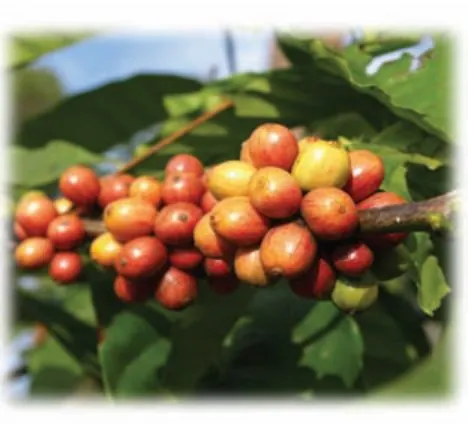 Coffee cherries – coffee plantation
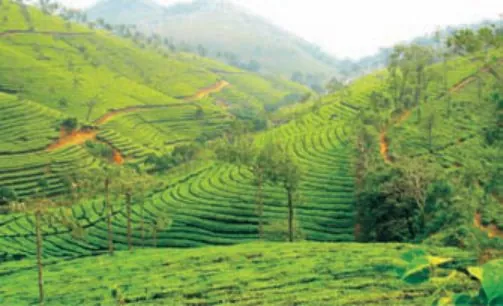 Tea plantation in the hill country
Map 5.1 – Areas where tea plantation is spread (Tea Research Institute marked with a star) — practise it on the interactive map.
Coconut plantation
Rubber tapping – rubber plantation Map 5.2 – Areas where coconut plantation is spread (Coconut Research Institute at Lunuwila) — practise it on the interactive map. Map 5.3 – Areas where rubber plantation is spread (Rubber Research Institute at Agalawatta) — practise it on the interactive map.
5.2 Social Change
Emergence of a middle class
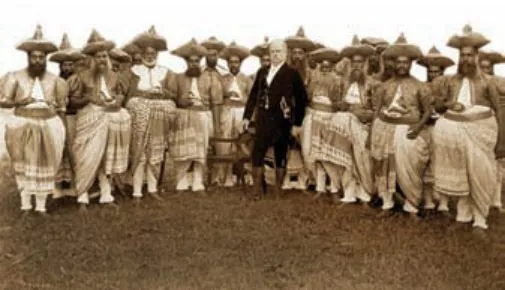
 A government agent and the Kandyan leaders – the old elite
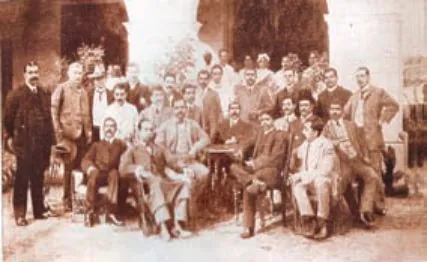
 A group of the new middle class
- Old aristocrats/elite (Kandyan chiefs etc.) declined; new local wealth from contracting, arrack renting, graphite mining, trade, transport, coconut plantations; English education opened careers (lawyers, engineers, surveyors, clerks, civil servants) → educated middle class (city-dwellers following Western culture) which led 20th-century politics.
Labour class
- Plantations needed labour → Indian (South Indian) Tamil labourers brought in thousands for low wages. Urban labourers (Colombo, Galle, Kandy) – dock workers, launderers, carters, road and rail workers – long hours, no insurance.
- Trade unions and strikes: printers, Colombo launderers, carters' strikes; A.E. Goonesinha (leader 1922–1935; Ceylon Labour Union / Ceylon Workers' Congress); LSSP unions; Natesa Aiyar organised estate workers.
Cultural change
- Western education and English spread after Colebrooke; mission and government-aided schools run by foreigners. Europeans' clubs and holiday resorts. Western dress, customs, greetings, architecture, food entered Sri Lankan life.
5.3 Advantages of British rule
Despite 133 years of exploitation: English language; transport and communication; export plantations; benefits of the industrial revolution; parliamentary system.
5.4 Disadvantages
Majority poor at independence; unequal income; decline of indigenous culture; alcohol spread; landless class; collapse of self-sufficient economy and indigenous knowledge; destruction of Gamsabha.
Important Facts
- Colebrooke reforms (1833) started wage labour and plantations.
- Coffee → tea (after 1869 blight); rubber and coconut grew c. 1900–1920.
- Middle class replaced aristocracy; Indian Tamil estate labourers.
Timeline
| Date | Event |
|---|---|
| 1833 | Colebrooke economic reforms |
| 1837–47 | Coffee boom |
| 1844 | Coffee crisis (free trade) |
| 1867 | Assam study tour |
| 1869 | Coffee leaf blight |
| c. 1877 | Rubber introduced |
| 1875 | 500 acres of tea; 1894 – 400 000 acres |
| 1880 | 65 % coconut owners Sri Lankan |
| 1920 | Coconut 27 %, rubber 30 % of export income |
| 1922–35 | Goonesinha's leadership |
Exam focus
- Colebrooke's economic reforms.
- Each plantation crop: dates, areas, problems.
- Rise of the middle and labour classes.
- Advantages and disadvantages of British rule.