
Textbook: Chapter 6 (printed pp. 79–105)
0. Introduction
Independence in 1948 gave Sri Lanka a parliamentary system of representative democracy; new constitutions followed in 1972 and 1978. This chapter also covers development after independence.
6.1 Soulbury Reforms and Independence
- Soulbury Commission arrived December 1944; report September 1945 – full internal self-government; State Council passed the white paper; Royal Order in Council May 1946.
- Britain was silent on independence before the 1947 election; D.S. Senanayake presented the case; Colonial Secretary announced independence within the Commonwealth two months before the election.
- United National Party formed (1946) by D.S. Senanayake.
1947 Parliamentary election
| Party | Seats |
|---|---|
| United National Party | 42 |
| Lanka Sama Samaja Party | 10 |
| Tamil Congress | 7 |
| Lanka Indian Congress | 6 |
| Bolshevik Leninist Party | 5 |
| Lanka Communist Party | 3 |
| Labour Party | 1 |
| Independents | 21 |
| Total | 95 |
- D.S. Senanayake formed the government with independents' support.
- November 1947 agreements: Defence agreement (British use of bases) and External Affairs agreement (British help with foreign relations).
- Independence Act; Order in Council 19 December 1947; independence on 4 February 1948; Parliament opened 10 February 1948 (Senanayake raised the Sri Lankan flag).
Soulbury Constitution (1947–1972)
| Institution | Details |
|---|---|
| Governor-General | Nominal head; represented the Queen; acted on PM's advice |
| Parliament | House of Representatives 101 (95 elected + 6 nominated by Governor-General for minorities); term 5 years; Senate 30 (15 elected by House, 15 nominated) |
| Prime Minister and Cabinet | PM commands majority of the House; cabinet holds executive power; Westminster system – collective responsibility; PM held defence and external affairs; Justice minister and one other from Senate |
| Judiciary | Supreme Court; Governor-General appoints Chief Justice and judges; Judicial Service Commission |
Political party system
- Two-party (Britain, USA) vs multi-party (France, Germany, India, Sri Lanka). Party politics began in the 1947 election.
- LSSP (1935) – N.M. Perera, Colvin R. de Silva, Philip Gunawardena; goal: socialist society; Communist Party (1943) – split under S.A. Wickramasinghe.
- UNP (1946) – D.S. Senanayake; included most of the Ceylon National Congress and Sinhala Maha Sabha; won 54 seats in 1952 and formed government.
- SLFP (1951) – S.W.R.D. Bandaranaike left UNP; won 9 seats (the textbook dates this election to 1951); contested 1956 in alliance as the Mahajana Eksath Peramuna (MEP) coalition – won 51 seats in 1956; he was PM 1956–59; after his assassination Sirimavo Bandaranaike became leader.
- Other parties: Labour Party (A.E. Goonesinha), Tamil Congress (G.G. Ponnambalam) – 7 seats 1947; Federal Party (1949, S.J.V. Chelvanayakam) which weakened Tamil Congress.
- Many small parties → coalition governments.
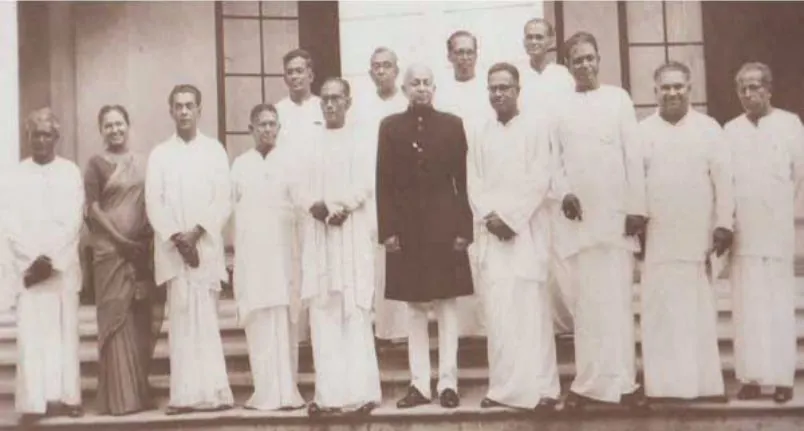 Fig 6.1 – S.W.R.D. Bandaranaike's cabinet
1956 election and "social revolution"
- D.S. Senanayake died March 1952; Dudley Senanayake PM; resigned 1953 over rice price protests; John Kotelawala PM; dissolved Parliament in February 1956.
- MEP = SLFP + Philip Gunawardena's Revolutionary Socialist Party + Vijayananda Dahanayake's Language Congress (Bhasha Peramuna) + independents (e.g., I.M.R.A. Iriyagolla); no-contest pact with LSSP.
- Issue: Sinhala as official language. Support of the Pancha Maha Balavegaya (monks, native physicians, teachers, farmers, workers).
- Seats: MEP 51, LSSP 14, Federal Party 10, UNP 8.
- Bandaranaike's policies: Sinhala as state language; ended 1947 defence and external-affairs agreements; non-aligned foreign policy; nationalised harbours and buses; promoted local industry and agriculture; Vidyodaya and Vidyalankara pirivenas made universities.
Republic of 1972
- Soulbury independence incomplete (Queen still head; restrictions on Parliament).
- 1970 election: United Front (SLFP + LSSP + Communist Party) won; Sirimavo Bandaranaike PM; Constituent Assembly → Constitution of 22 May 1972.
- Features: name Ceylon → Sri Lanka; ended constitutional link with Britain; unitary republic; fundamental rights (Article 18: impartial law; no deprivation of life/liberty except by law; freedom of thought, conscience, religion; peaceful assembly and expression).
- President – nominal executive, appointed by PM; William Gopallawa first president.
- National State Assembly – sole legislature; term 6 years.
- PM and Cabinet – executive.
- Courts: Supreme Court, High Court, District Court, Magistrate's Court, Constitutional Court; Judicial Service Advisory and Disciplinary Boards.
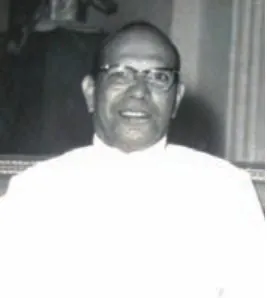 Fig 6.2 – William Gopallawa, first President
1978 Constitution
- 1977 election: UNP won 140 of 168 seats (> two-thirds); Tamil United Liberation Front 18; SLFP 8; plus Ceylon Workers' Congress 1 and one independent. J.R. Jayewardene introduced an executive presidency (from 1978).
- Name: Democratic Socialist Republic of Sri Lanka; unitary state; sovereignty of the people (exercised by Parliament, the President, the judiciary and by referendum).
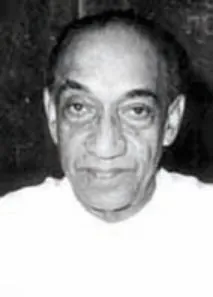 Fig 6.3 – J.R. Jayewardene
| Feature | 1978 Constitution |
|---|---|
| President | Elected by the people (term 6 years); head of state, government, executive, Parliament and commander-in-chief (Article 30). Powers: summon/prorogue/dissolve Parliament; present policy; appoint PM and ministers; appoint Supreme Court/Appeal Court judges; pardon; declare war and peace; immune from suit for official acts |
| PM and Cabinet | Cabinet appointed from MPs; collectively responsible to Parliament |
| Parliament | 225 members – 196 elected (proportional representation) + 29 national list |
| Judiciary | Supreme, Appeal, High, District, Family, Magistrate's and Primary Courts. Supreme Court – fundamental rights, impeachment, privileges, election petitions; Judicial Service Commission (Chief Justice + two judges) |
| Fundamental rights | Chapter III – wider and more detailed than 1972: equality before law, freedom of speech and opinion, freedom from harassment, religion, occupation; a person may petition the Supreme Court within three months (Article 129, as stated in the textbook); complaint to the Parliamentary Commissioner (Ombudsman) for public-sector rights |
| Elections | Presidential – whole island one electorate; 50 % needed; J.R. Jayewardene (first, 1978; re-elected 1982); later R. Premadasa, D.B. Wijetunga (not elected), Chandrika Kumaratunga, Mahinda Rajapaksa, Maithripala Sirisena |
| Proportional representation | Vote for party then preference votes |
| Referendum | First introduced in 1978; only one held: 1982 to extend Parliament; needs > 50 % |
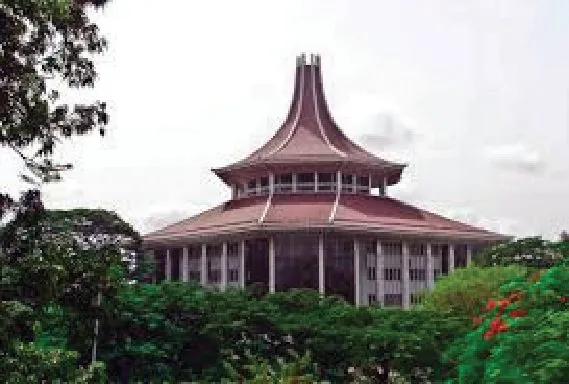 Fig 6.4 – Supreme Court
6.2 Development after Independence
Agriculture
- British neglected local food production; State Council (1931–47) under D.S. Senanayake (Minister of Agriculture) started dry-zone farming settlements (colonization).
- Aims: relieve wet-zone population and unemployment; increase food production; restore old tanks; settled farming community.
- Dry zone abandoned after Magha (700 years earlier) was re-used.
- Challenges: selecting settlers, clearing forest, irrigation, financial help until first harvest, health and education, marketing.
- Pre-independence colonies: Kagama, Minneriya, Nachchaduwa, Beragama, Minipe, Parakrama Samudra, Ridi Bendi Ela, Sangili Kanadarawa, Onichchei. After independence (to 1953): 15 more – Bathmadika, Devahuwa, Giritale, Paniyankadawala, Iranamadu, Gal Oya, Kantale, Sorabora Wewa etc. Gal Oya – first multi-purpose project.
Map 6.1 – Farming settlements — practise it on the interactive map.
Mahaweli Development Project
- Mahaweli rises in the western central hills, flows through Dumbara and enters the sea at Trincomalee.
- Aims: water for dry-zone farming; hydro-electricity; settlements and land for the landless; jobs, flood control, fish.
- Stage 1 (1970–77): Polgolla barrage diverting water to Sudu Ganga and Bowatenna reservoir → Kala Wewa, Nachchaduwa, Nuwara Wewa, Tissa Wewa. Original plan 30 years; J.R. Jayewardene speeded to 6 years; Ministry of Mahaweli Development (1978) – Minister Gamini Dissanayake; Mahaweli Authority (1979).
- Reservoirs: Kotmale (Sweden's aid; Kadadora dam across Kotmale Oya), Victoria (UK aid; hydro-electricity), Randenigala (West Germany aid), Rantambe, Ulhitiya, Ratkinda, Maduru Oya; Minipe anicut.
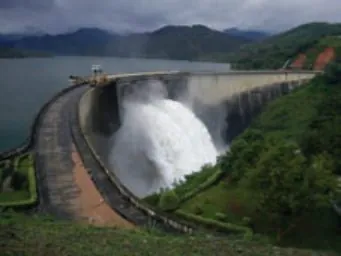 Victoria Reservoir – built a little below the Polgolla dam; main aim hydro-electricity (British aid)
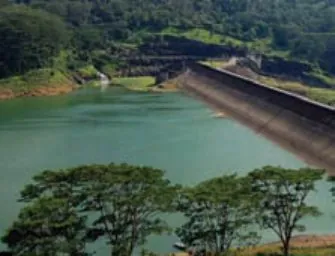 Kotmale Reservoir – dam at Kadadora across Kotmale Oya (Swedish aid)
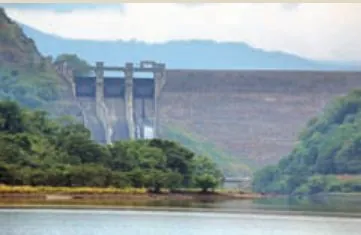 Randenigala Reservoir – below Victoria and above Minipe dam (West German aid)
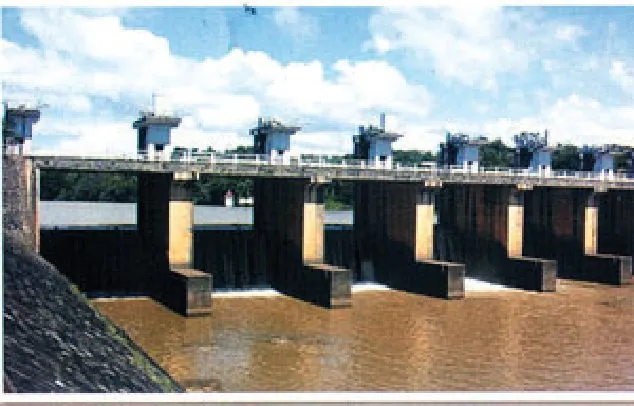 Fig 6.5 – Polgolla barrage
Map 6.2 – Water-supply projects of the accelerated Mahaweli Development Programme — practise it on the interactive map.
- Other paddy measures: guaranteed price (1948); paddy research (e.g., Bathalegoda breeding centre) and new varieties; Govijana Sewa (farming service) centres; loans through state banks.
Commercial crops
- Land Reform Law 1972: ceilings – 10 ha (25 acres) paddy, 20 ha (50 acres) other.
- 1975 land reform: companies' estates nationalised – about 62 % to state; 10 % of state land given to small farmers.
- Institutions: State Plantations Corporation (1958), Up-country Estate Development Bureau (1976) and People's Estate Development Bureau (1976).
- 1952 bilateral agreement with China gave a stable rubber market; re-planting aid scheme 1977 (plants and fertilizer for rubber, later tea).
- Small holders (1–10 acres) in West, South and Sabaragamuwa.
- Minor export crops (coffee, cocoa, cardamom, cloves, nutmeg, pepper, cinnamon): Tea Commission report 1968; Minor Export Crops research station Matale 1972; later Kundasale, Delpitiya, Narammala.
Industrialisation
- None under British; WWII stimulated local industries (acetic acid, porcelain, paper, soap, perfumes). 1934 Bank Commission recommended local industry. 1952 World Bank mission; 1955 White Paper; Ekala (1959) and Ratmalana (1960) industrial zones.
- After 1960: People's Bank (1961); Standards Bureau (1966); import substitution 1970–77; large industries (cement, steel, sugar, plywood).
- After 1977: export-oriented industries (e.g., garments) – the Greater Colombo Economic Commission (1978; "Mega Colombo" in the text), the Katunayake export processing zone (1978), later Biyagama and Koggala.
Education
- Free education (C.W.W. Kannangara, Minister of Education, State Council): grade 1 to university; continued thereafter.
- Milestones: more schools; curriculum and teacher-training; free textbooks, meals, medical care, uniforms and concessionary transport; Ceylon University 1942 (Colombo) → Peradeniya 1952; Vidyodaya → Sri Jayewardenepura, Vidyalankara → Kelaniya; Moratuwa/Katubedda 1972, Jaffna 1974.
6.3 Social Welfare
- Universal franchise made politicians attend to the poor; rural education, merit-based recruitment, constitutional rights, loans for agriculture and fisheries.
- Health: rural hospitals, maternity and child health, immunisation, clinics, Ayurveda; decline of influenza, filaria, malaria, TB, polio.
- Rural roads, water, electricity, communication.
- Rice subsidy – ration book (Hal Potha); food stamps from 1977.
- Housing: flats and housing schemes in cities; rural aid.
Important Facts
- 4 February 1948 – independence; Soulbury constitution (to 1972); 1972 republic; 1978 executive presidency.
- First PM: D.S. Senanayake; first president: William Gopallawa; first executive president: J.R. Jayewardene.
- Mahaweli: Polgolla, Victoria, Kotmale, Randenigala.
Timeline
| Date | Event |
|---|---|
| Dec 1944 / Sept 1945 | Soulbury visit / report |
| Nov 1947 | Defence and external-affairs agreements |
| 19 Dec 1947 | Independence Order in Council |
| 4 Feb 1948 | Independence |
| 1956 | MEP victory |
| 1970 | United Front |
| 22 May 1972 | Republic constitution |
| 1977 | UNP wins; 1978 constitution; Mahaweli ministry |
| 1982 | Referendum |
Exam focus
- Soulbury features and seat figures.
- 1956 election; policies of Bandaranaike.
- Compare 1972 and 1978 constitutions.
- Mahaweli aims and reservoirs.
Note on the textbook
The textbook states universal franchise was granted in 1931 but once says 1937; this resource uses 1931. It also dates the SLFP's 9-seat result to "1951" although the election was held in 1952, and it lists Dr. S.A. Wickramasinghe's party as formed in 1943.